AC
(DENNIS): When I read that the director insisted that the crew
continue filming during a hurricane, the first thing that came to
mind was how crazy a decision that was. Many directors wouldn't
put their actors in this position. What went through your mind when
he made that decision?
 |
 |
|
|
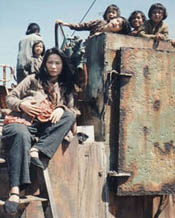
Birds
of Passage: Fu-Ling (Linda Wang) awaits her fate
on-board a ship to a brighter future.
|
|
|
LINDA: Well,
let's put it this way, the director of the film "Birds of Passage"
also wrote the screenplay and co-produced the film. He had tons
of responsibilities within this project and he he had to meet the
budgets and deadlines daily. He is well known in Europe for
directing award winning documentary films, and "Birds of Passage"
is his second feature film. There was a lot of tension among all of
us due to the weather conditions and the gorilla style type of filming.
I can't totally agree with all the decision-making, especially on
those hurricane rainstorm scenes involving young children. But then
again this is coming from an actor's point of view.
AC (DENNIS): With all the issues and fighting that went on in
that ship, did you feel at all scared that your life was in danger,
not with the natural causes but from the craziness occurring on
that ship?
LINDA: They took real animals for the sacrificing scenes
and hired children from orphanages in Cebu to portray the 109 Chinese
orphans within the film. With the help of the Filipino navy, they
used real M16 machine guns and battleships for the fighting scenes.
I was actually more concerned about the children onboard the ship.
But the production did hire the Filipino Navy Seals to protect us
just in case any of us fell off the ship or if there were water
or fire related accidents.
But
let me get back to your question. Yes, I was concerned. Ordeals
occurred each and every day. Everyone including myself was extremely
cautious and we all tried our best to do our jobs. I was learning
each and every day about the gorilla style type of filming which
was so fascinating. Also, having to deal with human relationship
in a confined and restricted space on broad a huge cargo ship in
long strenuous working hours each day was definitely a challenge.
Toward the middle of the filming, some European and Filipino film
crews would just walk off the set and never return. It was a mad
house and definitely was an experience of a lifetime.
AC
(DENNIS): You had a lot of fun filming in the Philippines but
when you returned to the US, what was the first thing you did?
LINDA: The first thing I did when I came back in New
York was rushed over to one of my favorite Italian family restaurants,
"Pete's Downtown" which is located near Old Fulton street
under the Brooklyn Bridge. I ordered my favorites such as "Zuppa
di Mussels", "Mushroom Timbale" & "Turbo
Livornese" and ate like a starving mad woman! (Laughter)
AC
(DENNIS): When you told your family and friends about your experience
shooting this movie, what kind of reaction did they have?
LINDA: They told me I must be insane! They couldn't believe
what all of us went through on the ship during the intense hurricane
rainstorm, and were extremely happy to see me back in one piece.
AC
(DENNIS): With other
Asian actresses I have interviewed, I have asked some if they
would ever do nude scenes. Actress Kelly Hu said that it depended
on the role and type of the movie. Actress/Model Esther Hwang said
never because once you show something, you lose the mystery. Would
you ever do any nude scenes in a movie?
LINDA: It really depends on the project itself and
the director. I have no problem with nudity as long as if it's justifiable
within the scene and the character that I am portraying. However,
I would never do a nude scene just because it can bring in more
profits and sells tickets.
 |
|
|
Photo
by Robert M. Putko
|
|
|
AC
(DENNIS): Let's talk
about the "Eskimo Girl" skit on Conan O'Brien? How did you
get involved in this skit?
LINDA: Initially, I have auditioned for them. They always
hire skit actors for the different skits on the show. Once you get
on the set a couple of times, you get to know the writers and the
people on the sets. I'm very fortunate because whenever they
need someone for skit works and it's suitable for my type of character,
they would consider me. One time I spoke to the casting director and
we talked about how even with non-traditional castings, with a character
that's funny and it doesn't have to be Asian to please consider
me for the part. They said why? We discussed about why they use Caucasian
actors for Eskimos and it made me very sad that with work so limited
for Asians on television and I told them that since the majority of
the Eskimos look Asian, why don't they hire Asians and they said I
made a good point. I believe in standing up for my rights. You need
to speak out.
AC
(DENNIS): I'm curious.
Do you like to watch yourself on television?
LINDA: No, because I am my worst critic.
AC
(DENNIS): Do you remember
your reaction when you first saw yourself on television?
LINDA: Oh my... Is that really me? I wish I could have done
that scene a totally different way.
AC
(DENNIS): What encouraging
words of advice would you give to a fellow reader who would like
to pursue a career in print modeling or acting?
LINDA: If you want to get into this business and are willing
to devote the time and effort to invest in yourself in whatever
obstacles within, then you are probably right for this business.
It's definitely not as glamorous as it appears to be. It takes an
intense desire, a professional attitude, well-developed skills,
persistence, talent and hard work. Many successful people
in this business fought against every possible obstacle until the
monster of defeat finally surrendered and they made it. So follow
your heart and dreams. Make sure this is what you love to do and
proceed with caution. And always remember to work on your craft
and do your research on this field and take it one step at a time.
Page
2 of Interview
Page
4 of Interview
|